
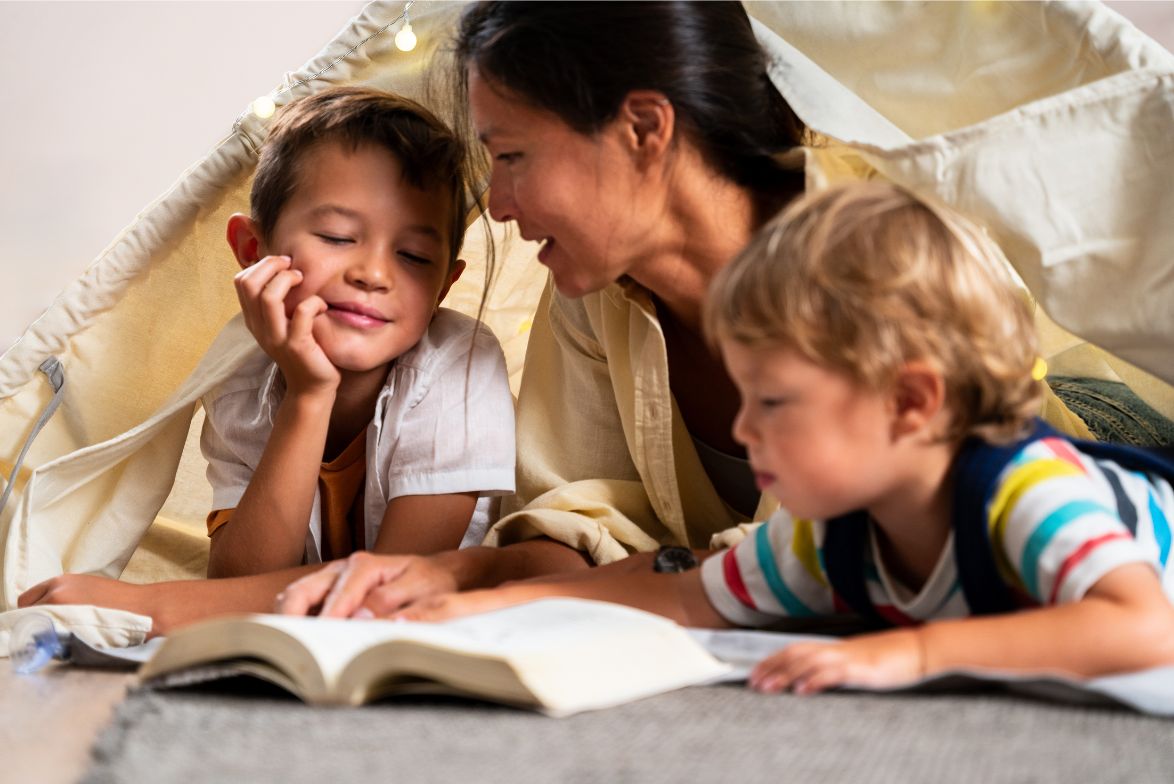

The other day, I overheard my 7-year-old humming softly as she played, “What is our only hope in life and death? That we are not our own but belong to God, that we are not our own but belong to God.” Those weren’t just random words she was singing—they were biblical truths hidden in her little heart, truths she may not fully grasp yet, but I believe, will grow into over the years. In that moment, I remembered why we began this journey of learning the catechism together as a family. These simple yet profound questions and answers are doing more than filling my children’s minds; they are quietly shaping their worldview, giving them a language for their faith, and anchoring them to God’s truth in a way that story Bibles and Sunday lessons alone may not.
Over the past year, we have been on a journey to memorise the New City Catechism with our children—and what a rich blessing it has been! It has naturally found its way into our family conversations, prayers, and even how we navigate everyday moments, helping our kids to grow in their understanding of who God is. And so, I wanted to share a glimpse into our experience and why I believe teaching catechism to children can be a powerful tool for family discipleship.
As a mom, when I first understood the depth and clarity of catechism memorisation, I realised what a treasure it could be for families seeking to go beyond just the familiar Bible stories to help their children grasp solid theological truths. I recognised its real purpose—to lay a foundation of faith not only rooted in Scripture, but also well-structured and built to last. But let’s rewind a little and start at the beginning.
What is Catechism?
Catechism comes from the Greek word katecheo, which means “to instruct” or “to teach.” Catechism is simply a method of teaching biblical truth in a systematic, clear, and structured manner. Most catechisms follow a question-and-answer format, each one accompanied by Scripture references—excellent passages to memorize alongside the catechism itself. This approach not only helps children (and adults!) retain key doctrines, but also invites thoughtful reflection and discussion, making it an excellent resource for family discipleship.
Martin Luther once said that parents shouldn’t simply shower their children with possessions, but should “enrich their souls with the arts, with study, with sound literature,” and most importantly, raise them “in the fear of God.” If we do this faithfully, he noted, we will find abundant opportunities to practice godliness within our own homes. Truly, the Bible is sufficient for this task—but theologically rich resources like catechisms can serve as helpful companions in our children’s spiritual formation.
Importance of Memorisation
Many of us didn’t grow up with catechism as part of our faith formation. But we did grow up memorising plenty—math tables, poems, even pages of textbook content—especially in the Indian education system, where rote learning is foundational. And we hated it.
I guess you’ve said this at least once in your lifetime – “I hated memorisation when I was a kid.” And that may be one reason why we are not too keen to get our kids to memorise things. We don’t want them to suffer like we did.
I get it. Memorisation can be difficult and tedious. It doesn’t have to be, but even if it is boring, it’s still essential.
Why?
Because, ultimately, it’s not in our hands whether our kids memorise things or not. All kids, all human beings everywhere, are memorising things all the time. Every time our kids watch a movie, read a book, or meet up with friends, they learn something. The jingle from their favourite TV show gets stuck in their heads. Something they hear or see will stick with them and leave a lasting impression on their minds. It may be something you approve of, or it may be something you are completely against. It may impact your child positively or negatively. Either way, the fact of the matter is that they are memorizing things every day, and those things will stay with them for life.
So, as far as memorisation is concerned, there is just one question we must ask ourselves: Who is going to control what our children memorise? Is it going to be us or is it going to be the world?
And if you want to control what your kids memorise, catechesis is one of the ways you can do this.
When we choose to catechise our kids, we are choosing to determine what exactly is going to stick with them forever, rather than allowing the world to decide that for us.
What Catechism is Not
Contrary to what many believe, protestants have a rich history of using catechisms as a means of teaching Biblical truth.
Catechism is not meant to replace the Bible—it is intended to support and deepen our understanding of it. It is also not a replacement for Scripture memorisation. It works hand-in-hand with Scripture, organising key truths in a way that helps us absorb, reflect on, and articulate them more clearly. Learning this was incredibly helpful for me as I considered whether to commit to memorising the catechism with our children or not. Understanding that its purpose is to draw us further into God’s Word, not away from it, gave me the confidence to choose the former.
Why New City Catechism?
When our kids were toddlers, we leaned on story Bibles and Scripture memory for family devotions. But now, as they are getting older, we’ve sensed the need for something more. They’ve begun asking more profound questions—about God, about faith—and we realised we needed a more structured way to help them dig into biblical truths.
What we loved about the New City Catechism is how simple it is for kids, yet it doesn’t compromise on the theological truths. There are 52 questions in total, meaning if you learn just one each week, you can go through the entire catechism in a year! Each question has a shorter children’s answer and a longer adult answer. That way, our kids can memorise the short answers, while we as parents have the fuller explanation right there to guide deeper conversations. And for those who want to dig in further, there are also supporting Bible verses and helpful commentaries from faithful men of God.
The New City Catechism is divided into three main parts:
- God, Creation & Fall, Law
- Christ, Redemption, Grace
- Spirit, Restoration, Growing in Grace
Going through these together has been such a gift for our family. It has given us a natural way to dig into the Big truths of the Bible—like “Who is God?”, “Who is the Redeemer?”, “What is our only hope in life and death?”, “If no one can keep the law, what is its purpose?” and so on.
Another reason we love New City Catechism is that it offers the option to memorise the questions and answers through song. It turns something that may have seemed dull and overwhelming into something fun! Instead of dreading catechism time, our kids enjoy it and look forward to it. The best part is that all the songs are readily available on Spotify or right in the New City Catechism app, and we can use them at home or even on the go.
Impact on our Family
It’s hard to put into words the significant impact memorising the catechisms together as a family has had on us. I’ve seen both my kids and myself grow in wisdom and our understanding of God. Some of the conversations we’ve had along the way have amazed me—deep, thought-provoking talks I never imagined having with a ten- and seven-year-old!
We’ve also noticed a change in the way they connect things. During family Bible reading or while listening to a Sunday sermon, it’s as if a lightbulb goes off when they recognise one of the catechism truths that ties in with what they’re hearing.
And their prayers? Those have been transformed, too. What used to be a simple “Help us to glorify you” has taken on so much more meaning. Now they’ll pray, “Help us to glorify you by loving you and obeying all your commands”—straight from the catechism answer to the question, How can we glorify God?
It hasn’t just made a difference in my kids’ lives, but has also had an enormous impact on me. I’ve also used the catechism answers in conversations with other people. I was surprised by how practical and helpful these truths are for daily life. As we keep reading and discussing the Bible together as a family, I’m so thankful for this resource—rooted in Scripture—that helps God’s Word dwell more deeply in my own heart.
A Tool in God’s Hands
Aside from the New City Catechism, there are so many wonderful catechisms you can use with your children—the Baptist Catechism, the Heidelberg Catechism, and many others. No matter which one you choose, you’re giving them something priceless: a well-rounded, biblical worldview. Through catechism, kids are introduced to their Creator, they learn how the world went wrong, and they see the good news of what God has done to make it right. Bit by bit, they’re grounded in the core truths of Scripture—truths that will one day give them strength when their faith is tested, especially as they grow older and face the pressures of the world.
I once read about John Newton, the author of the hymn Amazing Grace, a former slave trader who later became a preacher of the Good News. It is said that his conversion was significantly influenced by what his mother had taught him as a child through catechism. Even when he wandered away from God, the truths that were tucked deep in his heart stayed with him. Years later, when a violent storm nearly took his life, those truths came rushing back, stirring his heart to cry out for salvation.
That’s the beauty of catechism: the truths children memorise when they are young don’t just disappear. They remain, ready to be used as a tool in God’s hand—even years down the road.
A Lasting Legacy
Every day of our lives is different from another. Some days are full of laughter and joy, while others feel heavy and difficult to bear. In both the good and the bad, God is our anchor. But when life presses in, how do we hold on to those unshakable truths about His character and care?
We root ourselves in Scripture—reading, studying, and memorising it. We pray God’s Word back to Him, and speak the gospel into the lives of those around us. And one more tool that helps anchor us is the catechism. It gives us a way to learn and rehearse the core truths about God and His relationship with us in a focused, intentional way.
The reality is, children can learn so much more than we often give them credit for. The question isn’t, can they learn these truths, but will we as parents take the time to teach them? I often remind myself that the best legacy I can leave my children isn’t money or possessions, but a rich knowledge of God.
Just as toddlers learn vocabulary before grasping meaning, or young children memorise poetry before writing their own, they can learn the doctrine of faith through catechism, sometimes even before understanding it fully. But it gives us a shared vocabulary and a framework for talking about life with God—one that will serve them for years to come.
We can’t depend on the catechisms to save our children (because they can’t!), nor can we make all the spiritual connections for them, but we can spread a banquet of truth before them. And as we do, we pray that these truths, tucked into their hearts, will arise in everyday moments and change how they live their lives. Most of all, we pray that the Holy Spirit will use these truths to capture their hearts and draw them closer to Christ.
This article was first published on Indiaanya.